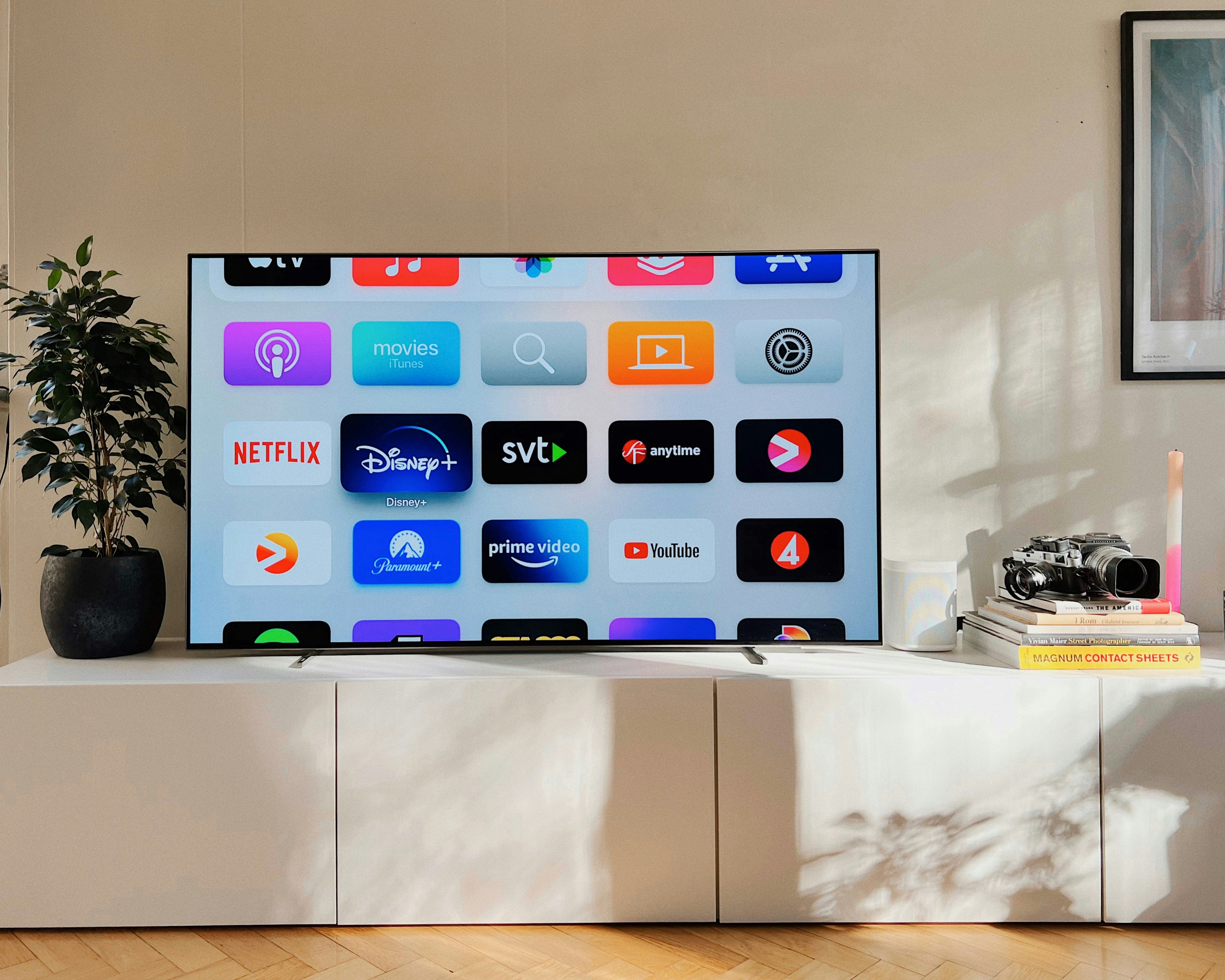
 Photo by Oscar Nord on Unsplash
Digital entertainment and communication are no longer just additions to our homes and routines. Whether it’s binge-watching your favorite TV series on Hulu, live-streaming online video games on Twitch, or attending Zoom meetings for work, streaming has become an essential part of our daily lives.
But to experience smooth, uninterrupted streaming, with pristine video quality and undistorted audio, you need more than just a decent internet speed; you also need the right amount of bandwidth. So, how much bandwidth do you actually need for streaming, especially movies and TV?
Below, we’ll take a closer look at bandwidth and examine the different factors each household should consider. With our guide in hand, we’ll help you determine the right internet plan for your needs.
The Basics of Bandwidth
Let’s begin by defining bandwidth, a concept that sometimes confuses internet customers. Bandwidth simply refers to the maximum amount of data your internet connection can transmit at a particular moment in time.
Typically, bandwidth is measured in megabits per second (Mbps), which is the amount of data your connection can handle every second. The higher your bandwidth, the more data you can send and receive quickly and smoothly.
Now, it’s easy (and even common) to confuse bandwidth and internet speed. Just remember that bandwidth measures the volume or quantity of information a network transfers each second, not the speed of its transmission. On the other hand, a connection’s maximum download and upload speeds determine the pace of a connection. Thus, internet speed is a separate metric from bandwidth, though, as we’ll see below, they are interrelated.
Why Better Bandwidth Matters
For some online activities, generous bandwidth is simply essential. And if you’re streaming anything—e.g., movies and TV series, online games, watching videos and live feeds, or video conference calling for remote work or staying in touch with loved ones—higher bandwidth is crucial, as each of those activities is heavily data-intensive.
Suppose your internet connection’s bandwidth isn’t strong enough; you can expect annoying glitches that have tortured internet users over the decades. Indeed, insufficient bandwidth leads to buffering, pixelation, or worst of all, dropped connections, even in the middle of binging your favorite show!
And as the number of devices throughout a home has increased dramatically, higher bandwidth is more important than ever. Just think about the number of smart TVs, smartphones, tablets, laptops, and smart speakers, all in use in your home. When these are used simultaneously, more bandwidth is “eaten up,” making bandwidth one of the most precious resources in your home when multiple devices are connected and in use simultaneously!
So Just How Much Bandwidth Is Enough?
Having explained its importance to a quality internet connection, how can a typical customer know if they have sufficient bandwidth? Well, despite the distinction between bandwidth (i.e., the quantity of data transmitted per second) and speed (i.e., the pace of the transfer of data), an internet connection’s bandwidth is primarily tied to its maximum download speed.
It’s also critical to keep in mind that each household is different; therefore, bandwidth needs will differ, too. What is needed for a family of four, with smart TVs streaming in multiple rooms at the same time, will be quite different than a home with just one person only streaming on one device. And we all know that with a high-bandwidth fiber connection, many people can stream TV in the background while simultaneously video chatting with their friends or even watching videos on their phone or tablets!
These distinctions do matter, and the more streaming devices are in use simultaneously, the more bandwidth is gobbled up. For now, just remember that with fiber internet, greater bandwidth brings higher speeds for greatly enhanced performance.
Bandwidth for Streaming TV and Movies
Now let’s consider bandwidth needs for streaming, as few things are more frustrating than relaxing at the end of a long day, only to struggle to enjoy a TV show with a buffering wheel endlessly cycling. When your family sees this and other symptoms of insufficient bandwidth, it’s a sign that it may be time to upgrade to fiber internet (if you haven’t already) or increase your speed plan.
To determine what the right package is for your streaming activities, there are general recommendations for download speeds per device streaming at any one time. Let’s repeat that—the speeds below are recommended for each individual device being used.
That is, if you have two smart TVs streaming in the house simultaneously, you need to multiply the recommended numbers below by two. If there are four smart TVs streaming at once, multiply by four, etc.
If you stream in Full HD (1080p), which many streaming services like Netflix now do, you’ll want between 8-to-10 Mbps just for that one online activity. Now, if you want even more magnificent picture quality in your streaming, such as 4K Ultra HD (2160p), the speed requirement nearly triples to 25 Mbps or more per device.
For a single smart TV streamer, a lower speed tier plan likely provides enough bandwidth to suffice. But once you add other devices—and people using them at the same time—significantly more bandwidth is needed, and thus a higher speed tier to deliver it.
Consider this example: a family of four has four smart TVs all streaming at 8:00 PM in different rooms. If everyone wants to stream in 4K Ultra HD, that requires at least 100 Mbps just to meet the demands of bandwidth for all that simultaneous streaming in higher definition! And that is the absolute minimum.
It also doesn’t take into account any other online activities that those four streamers may also be doing. Once you add in scrolling through YouTube or TikTok videos, even more bandwidth is used up by the household.
And of course, there are likely numerous smart devices spread throughout your home, too. Smart doorbells and security cameras use bandwidth, as do smart speakers and smart appliances. Each of these use bandwidth in the background just to operate properly.
Taken together, you’re very likely to need a much higher speed to get the robust quantity of bandwidth for your home in order to experience the kind of quality streaming you expect. That is why many households need 300 Mbps to 500 Mbps plans—at a minimum—and many more families will benefit substantially from 1 Gigabit per second or higher available on fiber.
Budgeting Bandwidth
It may be helpful to think about accounting for bandwidth the way you budget for other things, like monthly groceries and other bills. Do the simple math we illustrate above (i.e., the number of simultaneous streamers and online activities, etc.) and multiply accordingly. That should give you a rough figure of what your household’s speed plan should be.
Additionally, as a rule of thumb, always budget for extra bandwidth to accommodate multiple users (e.g., guests), future tech upgrades (e.g., a new smart TV with state-of-the-art picture quality), new interests (e.g. online gaming), and unexpected demands (e.g., remote or hybrid working opportunities). It’s better to have more speed than you need than not enough when it matters most.
Like you, we understand that streaming is no longer a luxury; it’s practically a way of life for entertainment, work productivity, learning, and more meaningful communication through video calling. When you’re ready to enhance your home’s streaming capabilities by boosting its bandwidth, the knowledgeable agents at TEC are prepared to help you determine the best speed plans to fit your unique needs and budget. Give our Fiber Team a call at 833.832.3423 or head over to www.tec.com/signup.